


Election season brings political candidates and elected officials closer to the public. Candidates attend community events, knock on doors, participate in town halls, visit businesses and make themselves available to the people they hope to represent.
That accessibility is an important part of representative government. It also creates security challenges.
As the United States moves through the 2026 midterm election cycle, recent findings from the United States and United Kingdom show that threats, harassment and intimidation directed at elected officials and political candidates remain a serious concern. By several important measures, the problem is getting worse.
The challenge is also much broader than the traditional image of a politician surrounded by security personnel. Protecting elected officials increasingly requires an integrated combination of protective intelligence, threat monitoring, residential security, event security, close protection and coordination with law enforcement.
The objective is not simply to respond after a threat appears. It is to recognize warning signs early enough to determine what information matters and what action may be appropriate.
Key Takeaways
- U.S. Capitol Police investigated 14,938 threat assessment cases in 2025, approximately 58 percent more than in 2024.
- Online hostility becomes a physical security concern when it combines with fixation, doxxing, schedule research, repeated contact or approaches to homes and events.
- Effective protection integrates protective intelligence, residential and event security, close protection when warranted, and coordination with law enforcement.
- Security measures should be risk based and must distinguish legitimate political speech and peaceful protest from behavior relevant to safety.
Threats Against U.S. Elected Officials Continue to Rise
The scale of the problem is particularly clear in data released by the United States Capitol Police.
In January 2026, the U.S. Capitol Police reported that its Threat Assessment Section investigated 14,938 concerning statements, behaviors and communications during 2025 involving Members of Congress, their families, staff or the Capitol Complex.
That represented a significant increase from 9,474 cases in 2024 and 8,008 cases in 2023. From 2024 to 2025 alone, the number increased by approximately 58 percent.
Those numbers require context. A threat assessment case does not necessarily represent a confirmed threat or imminent attack. Threat assessment professionals intentionally examine a broader range of concerning communications and behavior because the purpose is to determine which situations may become more serious.
This creates one of the central challenges in modern protective intelligence. Security professionals cannot treat every angry social media comment or hostile email as evidence of an impending attack. At the same time, dismissing everything that falls short of an explicit threat can cause important warning signs to be overlooked.
The difficult work exists between those two extremes.
The U.S. Capitol Police has responded by expanding both its protective intelligence capabilities and its partnerships with law enforcement agencies around the country. During 2025, formal agreements between Capitol Police and partner agencies increased from approximately 115 departments to more than 350. The agency also expanded its 24/7 Protective Intelligence Operations Center, which receives and processes reports related to the safety of Members of Congress.
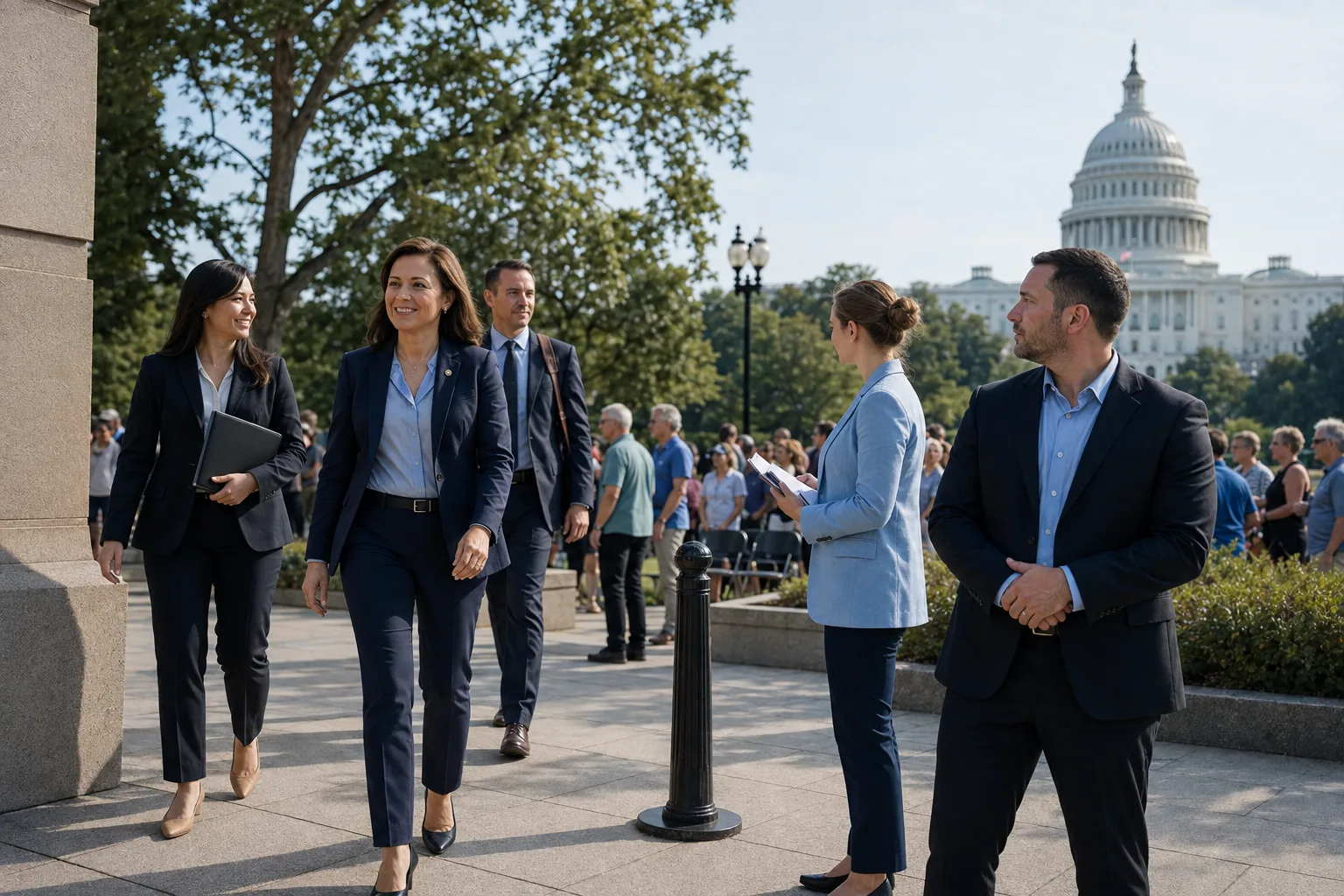
This reflects an important reality. Protection of elected officials cannot begin and end at the Capitol. Members of Congress live in communities, maintain district offices, travel, attend public events and spend time with their families. Candidates operate campaign offices, attend events at unfamiliar locations and maintain public schedules. The protective environment follows the person rather than remaining confined to a government building.
How Online Activity Can Become a Physical Security Risk
The June 2025 attacks against Minnesota state legislators demonstrated how digital information, personal information and physical targeting can converge.
According to the U.S. Department of Justice, the individual charged in connection with the attacks conducted research and planning before traveling to the homes of elected officials. Minnesota House Speaker Emerita Melissa Hortman and her husband, Mark, were killed. State Senator John Hoffman and his wife, Yvette, were shot and seriously wounded.
Investigators recovered notebooks containing the names of dozens of Minnesota state and federal elected officials. Many entries also contained residential addresses.
The case represents an extreme form of targeted violence, but it illustrates a much broader protective security problem.
Information about public officials has become remarkably easy to locate and combine. Social media posts can reveal routines. Public records can expose residential information. Event announcements can identify future locations. Photographs can reveal family members, vehicles, schools, neighborhoods and patterns of activity.
Individually, many of these pieces of information may not appear significant. A hostile social media post may mean very little. A publicly available address may mean very little. Someone attending multiple political events may have a completely legitimate reason for doing so.
The assessment changes when those pieces begin to form a pattern. Repeated hostile communications, fixation on a particular person, collection of personal information, unusual interest in schedules, attempts to approach a residence, escalating rhetoric or repeated unwanted contact may become significantly more important when viewed together.
This is where protective intelligence becomes critical.
Protective intelligence is not simply the collection of information. It is the process of identifying, evaluating and contextualizing information; determining whether behavior is changing; and deciding when additional protective measures or law enforcement involvement may be appropriate.
The United Kingdom Faces Similar Challenges

The threat environment affecting elected officials is not uniquely American.
The United Kingdom has also experienced significant concerns involving threats, harassment and intimidation of Members of Parliament and political candidates.
The House of Commons established a Speaker's Conference on the Security of MPs, Candidates and Elections to examine these issues. Its 2025 reports described a significant level of abuse experienced by political representatives.
Among MPs who responded to the Speaker's Conference survey, 96 percent reported experiencing at least one form of harassment, abuse or intimidation.
Parliament appropriately cautioned that participation in the survey was voluntary and that the findings should not automatically be considered representative of every Member of Parliament. Even with that limitation, the results demonstrate the seriousness of the issue among those who participated.
Research from the UK Electoral Commission following the 2024 UK Parliamentary general election provides additional insight.
The Electoral Commission found that 70 percent of responding candidates experienced at least one of the listed forms of harassment, intimidation or abuse during the campaign.
The security implications affected how candidates conducted their campaigns. Fifty-six percent said they avoided at least one form of campaign activity because they feared abuse, while 44 percent reported avoiding campaigning alone at least once.
One third of respondents said they had been intentionally intimidated or made to feel unsafe during their campaign.
Perhaps just as important, only 21 percent of candidates who experienced abuse, harassment or intimidation reported it to police.
That reporting gap creates its own security problem. A threatening communication that appears unimportant to one campaign worker may become significantly more relevant if the same individual has contacted multiple officials, repeatedly approached campaign events or engaged in similar behavior elsewhere.
If that information is never documented or reported, those connections become much harder to identify.
The United Kingdom has responded by strengthening security support for candidates and elected officials. In April 2025, the UK government announced that dedicated police officers were in place across all police forces to provide specialized security support to candidates participating in local elections.
The broader direction is similar in the United States and United Kingdom. Protection of political figures is becoming more intelligence led, coordinated and connected to local law enforcement.
That work continued in 2026. In March, the House of Commons published formal responses from the UK government and organizations including the National Police Chiefs' Council, Parliamentary Security Department, Electoral Commission and Ofcom to recommendations made by the Speaker's Conference.
How Digital Threats Connect to Physical Security
Separating online threats from physical security has also become increasingly difficult.
In December 2025, the FBI warned that malicious actors were impersonating senior U.S. officials through text messages and AI generated voice communications. According to the FBI, targets included government officials, family members and personal acquaintances.
At first glance, an impersonation campaign may appear to be primarily a cybersecurity concern. For protective security teams, the implications can be much broader.
A compromised account can expose contacts. Social engineering can reveal schedules or travel information. A family member may unknowingly provide information to someone they believe is a trusted contact. Publicly available photographs and social media content can provide details about residences, vehicles and routines.
Information gathered in the digital environment can ultimately support activity in the physical world.
The UK's National Protective Security Authority similarly advises high-risk individuals to consider publicly discoverable home and work addresses, predictable travel patterns, online exposure and changes in the broader threat environment.
For elected officials and political candidates, cybersecurity, information security, physical security and protective intelligence can no longer be viewed as completely separate disciplines. They are parts of the same risk picture.
Why Protection Begins Before the Protective Detail Arrives
When many people think about security for elected officials, they picture a close protection officer standing near the principal.
Close protection can be an essential component of a security program, particularly when a credible threat exists or when the individual's profile, public activities or operating environment justify additional protection.
It is still only one part of the protective system.
A comprehensive program begins with understanding the threat environment. That may include ongoing threat monitoring and protective intelligence; residential security assessments; evaluation of publicly exposed personal information; advance work before public appearances; route and travel risk assessments; staff reporting procedures; and coordination with local or federal law enforcement.
Physical security personnel can then be added or adjusted based on the actual level of risk.
The objective is not to isolate elected officials from the public. Political leaders and candidates need to interact with constituents. They need to attend events, answer questions and participate in the communities they represent.
Effective security should make that engagement safer without unnecessarily interfering with it.
How Protective Intelligence Helps Identify What Matters

Modern security teams rarely suffer from a complete lack of information. More often, they face the opposite problem.
News reporting, social media, public forums, email, campaign communications, protest activity, government alerts and open source data can generate enormous amounts of information every day.
Most of that information will never develop into a physical threat. The challenge is identifying what deserves closer attention.
A protective intelligence program must therefore do more than collect information. It must evaluate context.
Has someone contacted the official repeatedly? Has the tone or frequency of those communications changed? Is an individual demonstrating an unusual level of fixation? Has personal information been collected or distributed? Does an individual appear to know details about residences, family members or future schedules? Has online activity begun to correspond with physical approaches or attempts to make contact?
None of these indicators automatically proves that someone intends violence.
The significance comes from examining the totality of the circumstances and identifying changes in behavior over time.
Technology can help security teams collect, organize and prioritize large volumes of information. Human judgment remains essential when determining what the information actually means and what response may be appropriate.
Why Residential Security Matters for Elected Officials
An elected official's security environment does not end when the workday is over.
The residence can be one of the most sensitive parts of the protective picture because it often involves family members who never chose to participate in public life.
Government buildings frequently have controlled access, security screening and trained personnel. Private residences rarely have the same level of protection.
That does not mean every elected official requires around-the-clock residential security.
The appropriate response depends on the threat, the individual's public profile, the location, existing vulnerabilities and available resources.
For some officials, improved lighting, cameras, access control and updated emergency procedures may be appropriate. Others may require periodic patrols, residential security personnel or a more comprehensive protective presence.
The important point is that residential security should be considered part of the overall protective strategy rather than addressed only after a threat has already reached the home.
Why Election Season Increases Security Exposure
Campaigning naturally increases contact between candidates and the public.
Schedules become more visible. Candidates attend locations they may not regularly visit. Volunteers and temporary staff become part of the organization. Door-to-door campaigning creates direct interactions with strangers. Public meetings can become emotionally charged. Controversial events can rapidly change the threat environment.
At the same time, political discussions online can become increasingly hostile during election periods.
This does not mean every candidate needs a full-time close protection detail. It means security should be based on risk rather than assumption.
A candidate with a relatively low threat profile may initially require basic threat monitoring, staff awareness and event security planning. A controversial event or increase in threatening communications may justify additional protective measures. A credible or escalating threat may require immediate coordination with law enforcement and a significant change in protective posture.
An effective system must be capable of adjusting as the risk changes.
How to Protect Public Officials Without Restricting Democracy
One of the most important distinctions in this discussion is the difference between political disagreement and threatening behavior.
Political disagreement is not a security threat.
Criticism of elected officials, including strong criticism, is part of democratic society. Peaceful protest is also a legitimate form of political expression.
Security programs must preserve that distinction.
The concern begins when behavior moves toward threats, targeted harassment, stalking, intimidation, doxxing, persistent fixation or activity that may indicate preparation for violence.
Protective intelligence should therefore focus on behavior relevant to safety, not political beliefs or viewpoints.
That distinction is both operationally important and necessary to maintain trust.
How an Intelligence Led Security Program Protects Elected Officials
The United States and United Kingdom have different political systems, security structures and law enforcement frameworks, but the challenges facing elected officials increasingly share common characteristics.
Threats can begin online and move into the physical world. Residences and family members may become part of the targeting environment. Publicly available information can create vulnerabilities. Campaigning increases accessibility and unpredictability. Law enforcement may hold information that private security teams do not have, while campaign staff or protection teams may observe behavior that has not yet reached law enforcement.
Those pieces must be connected.
This is why effective protection increasingly depends on a coordinated protective intelligence function that can identify signals, assess relevance, document patterns and communicate important information to the appropriate law enforcement partners.
At Samaritan, our experience protecting elected officials and other high profile individuals in the Washington, D.C., area has reinforced the importance of this layered approach. Residential security, close protection and physical security remain essential capabilities, but they are strongest when supported by effective threat monitoring, protective intelligence and professional coordination.
The goal is not simply to place someone beside the principal. The goal is to understand the environment surrounding the principal well enough to recognize when something changes.
As the United States moves deeper into the 2026 midterm election cycle, the available evidence suggests that the risks facing elected officials are not disappearing. The same is true in the United Kingdom, where government, Parliament, candidates and law enforcement continue to reassess how public officials can remain accessible without accepting threats and intimidation as an inevitable part of public service.
Effective protection begins with information.
It requires the ability to identify signals early, separate meaningful indicators from background noise, understand how threats develop and ensure that the right information reaches the people capable of acting on it.
Physical security remains critical.
In today's threat environment, however, the strongest protective programs combine people, intelligence, planning, physical security and law enforcement partnerships into one coordinated system.
Frequently Asked Questions
Are threats against elected officials increasing in 2026?
Available data show that the threat environment remains elevated and, by several measures, is increasing. U.S. Capitol Police reported 14,938 threat assessment cases during 2025, compared with 9,474 in 2024 and 8,008 in 2023. These cases include concerning statements, behaviors and communications and are not all confirmed threats. In the United Kingdom, Parliament and the Electoral Commission have also documented significant levels of harassment, intimidation and abuse involving MPs and political candidates.
What does protective intelligence mean?
Protective intelligence is the process of collecting, evaluating and assessing information that may be relevant to the safety of a protected person, location or organization. It helps security professionals identify concerning behavior, determine whether patterns are developing and decide when protective measures or law enforcement coordination may be appropriate.
Does every elected official need close protection?
No. Protective measures should be based on threat, vulnerability, exposure and consequence. Some officials or candidates may require ongoing close protection, while others may be better served through threat monitoring, residential security assessments, event planning, staff training and law enforcement coordination. The protective posture should change when the risk changes.
Why is residential security important for elected officials and their families?
Residences are often less protected than government buildings and can expose spouses, children and other family members to the consequences of threats directed at a public official. Residential security assessments help identify vulnerabilities and determine whether improvements to physical security, monitoring, access control or protective staffing are appropriate.
How can social media create physical security risks for political candidates?
Social media can increase exposure by revealing schedules, locations, family relationships, routines and other personal information. It can also enable harassment, fixation, doxxing and threatening communications. Protective intelligence helps evaluate online activity in context and determine when digital behavior may have implications for physical security.
What security measures help protect elected officials during election season?
Risk based measures may include threat monitoring, protective intelligence, advance work, event security planning, residential security assessments, staff reporting procedures, travel risk assessments, close protection when warranted, and established law enforcement contacts. The appropriate combination should change as the threat, vulnerability and exposure change.
When should a campaign or security team contact law enforcement?
Campaigns and security teams should contact law enforcement immediately for credible or imminent threats, stalking, suspicious approaches, targeted doxxing accompanied by threats, or behavior that may indicate preparation for violence. They should also establish reporting protocols and points of contact before an incident occurs and follow jurisdiction-specific guidance.
Sources and Further Reading
United States Capitol Police, "USCP Threat Assessment Cases for 2025," January 27, 2026.
Reports 14,938 threat-assessment cases during 2025, comparison figures for 2024 and 2023, expansion of law enforcement agreements, and the 24/7 Protective Intelligence Operations Center.
Direct URL: https://www.uscp.gov/media-center/press-releases/uscp-threat-assessment-cases-2025
United States Capitol Police, "USCP Threat Assessment Cases for 2024," February 3, 2025.
Provides the 2024 threat-assessment figure and USCP context regarding election-year increases and coordination with law enforcement.
Direct URL: https://www.uscp.gov/media-center/press-releases/uscp-threat-assessment-cases-2024
U.S. Department of Justice, "After Two-Day Manhunt, Suspect Charged with Shooting Two Minnesota Lawmakers and Their Spouses," June 16, 2025.
Federal case information describing the targeted attacks and the recovery of notes listing dozens of state and federal elected officials, often with home addresses.
Federal Bureau of Investigation, "Senior U.S. Officials Continue To Be Impersonated in Malicious Messaging Campaign," December 19, 2025.
Details malicious text messaging, AI generated voice impersonation, and targeting of government officials, family members, and personal acquaintances.
UK House of Commons, "The Speaker's Conference on the security of MPs, candidates and elections," Second Report of Session 2024-26, October 27, 2025.
Reports that 96 percent of MPs responding to the survey had experienced at least one form of abuse, intimidation, or harassment and discusses online abuse and the wider democratic impact.
Direct URL: https://publications.parliament.uk/pa/cm5901/cmselect/cmspeak/1303/report.html
UK House of Commons, "Speaker's Conference on the security of MPs, candidates and elections: Government Response," March 5, 2026.
Publishes formal responses from the UK government and relevant organizations to the Speaker's Conference recommendations on threats, security support, policing, online abuse and democratic participation.
Direct URL: https://publications.parliament.uk/pa/cm5901/cmselect/cmspeak/1709/report.html
UK Electoral Commission, "Evidence to the Speaker's Conference on the security of candidates, MPs and elections," March 13, 2025.
Reports that 70 percent of responding candidates experienced at least one listed form of abuse or harassment, 56 percent avoided some campaign activity because of fear of abuse, 44 percent avoided campaigning alone at least once, and only 21 percent of those who experienced abuse reported it to police.
UK Government, Home Office, "Security support for local election candidates during campaign," April 10, 2025.
Describes dedicated police officers across UK forces offering specialized security support to local election candidates.
Direct URL: https://www.gov.uk/government/news/security-support-for-local-election-candidates-during-campaign
UK National Protective Security Authority, "Defending Democracy."
Provides protective security guidance for elected representatives, candidates, political organizations, and others involved in democratic institutions and elections.
Direct URL: https://www.npsa.gov.uk/national-security-act/defending-democracy
UK National Protective Security Authority, "Personal Safety & Security for High-Risk Individuals."
Addresses online and in-person incidents, publicly discoverable addresses, predictable movements, and other vulnerabilities relevant to high-risk individuals.
Direct URL: https://www.npsa.gov.uk/specialised-guidance/personal-safety-security-high-risk-individuals
UK National Protective Security Authority, "Protective Security Guidance - Staying Safe Online."
Explains how online information can support attack planning and recommends limiting advance details about times, locations, routes, residences, family, and other personal information.